Saturday, July 22, 2017

All Completed: Michael Hartl's Ruby on Rails Tutorial (Part 2)

sample_app Michael Hartl's Ruby on Rails Tutorial log

shell terminal
$ rails generate integration_test following

test/fixtures/relationships.yml
one:
  follower: michael
  followed: lana

two:
  follower: michael
  followed: malory

three:
  follower: lana
  followed: michael

four:
  follower: archer
  followed: michael

test/integration/following_test.rb
require 'test_helper'

class FollowingTest < ActionDispatch::IntegrationTest

  def setup
    @user = users(:michael)
    log_in_as(@user)
  end

  test "following page" do
    get following_user_path(@user)
    assert_not @user.following.empty?
    assert_match @user.following.count.to_s, response.body
    @user.following.each do |user|
      assert_select "a[href=?]", user_path(user)
    end
  end

  test "followers page" do
    get followers_user_path(@user)
    assert_not @user.followers.empty?
    assert_match @user.followers.count.to_s, response.body
    @user.followers.each do |user|
      assert_select "a[href=?]", user_path(user)
    end
  end
end

shell terminal
$ rails generate controller Relationships

test/controllers/relationships_controller_test.rb
require 'test_helper'

class RelationshipsControllerTest < ActionDispatch::IntegrationTest

  test "create should require logged-in user" do
    assert_no_difference 'Relationship.count' do
      post relationships_path
    end
    assert_redirected_to login_url
  end

  test "destroy should require logged-in user" do
    assert_no_difference 'Relationship.count' do
      delete relationship_path(relationships(:one))
    end
    assert_redirected_to login_url
  end   
   
end

app/controllers/relationships_controller.rb
class RelationshipsController < ApplicationController
  before_action :logged_in_user

  def create
    user = User.find(params[:followed_id])
    current_user.follow(user)
    redirect_to user
  end

  def destroy
    user = Relationship.find(params[:id]).followed
    current_user.unfollow(user)
    redirect_to user
  end

end

app/views/users/_follow.html.erb
<%= form_for(current_user.active_relationships.build, remote: true) do |f| %>
  <div><%= hidden_field_tag :followed_id, @user.id %></div>
  <%= f.submit "Follow", class: "btn btn-primary" %>
<% end %>

app/views/users/_unfollow.html.erb
<%= form_for(current_user.active_relationships.find_by(followed_id: @user.id),
             html: { method: :delete },
             remote: true) do |f| %>
  <%= f.submit "Unfollow", class: "btn" %>
<% end %>

app/controllers/relationships_controller.rb
class RelationshipsController < ApplicationController
  before_action :logged_in_user

  def create
    user = User.find(params[:followed_id])
    current_user.follow(user)
    respond_to do |format|
      format.html { redirect_to @user }
      format.js
    end
  end

  def destroy
    user = Relationship.find(params[:id]).followed
    current_user.unfollow(user)
    respond_to do |format|
      format.html { redirect_to @user }
      format.js
    end
  end

end

config/application.rb
require_relative 'boot'

require 'rails/all'

require File.expand_path('../boot', __FILE__)

# Require the gems listed in Gemfile, including any gems
# you've limited to :test, :development, or :production.
Bundler.require(*Rails.groups)

module SampleApp
  class Application < Rails::Application
    # Settings in config/environments/* take precedence over those specified here.
    # Application configuration should go into files in config/initializers
    # -- all .rb files in that directory are automatically loaded.
     
    # Include the authenticity token in remote forms.
    config.action_view.embed_authenticity_token_in_remote_forms = true
           
  end
end

test/integration/following_test.rb
require 'test_helper'

class FollowingTest < ActionDispatch::IntegrationTest

  def setup
    @user = users(:michael)
    @other = users(:archer)     
    log_in_as(@user)
  end

  test "following page" do
    get following_user_path(@user)
    assert_not @user.following.empty?
    assert_match @user.following.count.to_s, response.body
    @user.following.each do |user|
      assert_select "a[href=?]", user_path(user)
    end
  end

  test "followers page" do
    get followers_user_path(@user)
    assert_not @user.followers.empty?
    assert_match @user.followers.count.to_s, response.body
    @user.followers.each do |user|
      assert_select "a[href=?]", user_path(user)
    end
  end   

  test "should follow a user the standard way" do
    assert_difference '@user.following.count', 1 do
      post relationships_path, params: { followed_id: @other.id }
    end
  end

#  test "should follow a user with Ajax" do
#    assert_difference '@user.following.count', 1 do
#      post relationships_path, xhr: true, params: { followed_id: @other.id }
#    end
#  end

  test "should unfollow a user the standard way" do
    @user.follow(@other)
    relationship = @user.active_relationships.find_by(followed_id: @other.id)
    assert_difference '@user.following.count', -1 do
      delete relationship_path(relationship)
    end
  end

#  test "should unfollow a user with Ajax" do
#    @user.follow(@other)
#    relationship = @user.active_relationships.find_by(followed_id: @other.id)
#    assert_difference '@user.following.count', -1 do
#      delete relationship_path(relationship), xhr: true
#    end
#  end   
   
end

test/models/user_test.rb
  test "feed should have the right posts" do
    michael = users(:michael)
    archer  = users(:archer)
    lana    = users(:lana)
    # Posts from followed user
    lana.microposts.each do |post_following|
      assert michael.feed.include?(post_following)
    end
    # Posts from self
    michael.microposts.each do |post_self|
      assert michael.feed.include?(post_self)
    end
    # Posts from unfollowed user
    archer.microposts.each do |post_unfollowed|
      assert_not michael.feed.include?(post_unfollowed)
    end
  end

app/models/user.rb
  # Returns a user's status feed.
  def feed
    Micropost.where("user_id IN (?) OR user_id = ?", following_ids, id)
  end

  # Follows a user.
  def follow(other_user)
    active_relationships.create(followed_id: other_user.id)
  end

app/models/user.rb
  # Returns a user's status feed.
  def feed
    Micropost.where("user_id IN (:following_ids) OR user_id = :user_id",
                    following_ids: following_ids, user_id: id)
  end

app/models/user.rb
  # Returns a user's status feed.
  def feed
    following_ids = "SELECT followed_id FROM relationships
                     WHERE  follower_id = :user_id"
    Micropost.where("user_id IN (#{following_ids})
                     OR user_id = :user_id", user_id: id)
  end


shell terminal
$ rails test
$ git add -A
$ git commit -m "Add user following"
$ git checkout master
$ git merge following-users
$ git push

Github URL for sample_app project: https://github.com/jimmy2046/sample_app

  • I completed all 14 chapters on July 22, 2017.

All Completed: Michael Hartl's Ruby on Rails Tutorial (Part I)

sample_app: Chapter 14 Following users log

shell terminal
$ cd sample_app
$ rails s -b 0.0.0.0 -p 3000

Firefox: http://localhost:3000/

shell terminal
$ git checkout -b following-users


$ rails generate model Relationship follower_id:integer followed_id:integer

db/migrate/[timestamp]_create_relationships.rb
    add_index :relationships, :follower_id
    add_index :relationships, :followed_id
    add_index :relationships, [:follower_id, :followed_id], unique: true

$ rails db:migrate
== 20170722215137 CreateRelationships: migrating ==============================
-- create_table(:relationships)
   -> 0.0247s
-- add_index(:relationships, :follower_id)
   -> 0.0011s
-- add_index(:relationships, :followed_id)
   -> 0.0011s
-- add_index(:relationships, [:follower_id, :followed_id], {:unique=>true})
   -> 0.0016s
== 20170722215137 CreateRelationships: migrated (0.0288s) =====================

app/models/user.rb
  has_many :active_relationships, class_name:  "Relationship",
                                  foreign_key: "follower_id",
                                  dependent:   :destroy


app/models/relationship.rb
class Relationship < ApplicationRecord
  belongs_to :follower, class_name: "User"
  belongs_to :followed, class_name: "User"   
end

test/models/relationship_test.rb
require 'test_helper'

class RelationshipTest < ActiveSupport::TestCase

  def setup
    @relationship = Relationship.new(follower_id: users(:michael).id,
                                     followed_id: users(:archer).id)
  end

  test "should be valid" do
    assert @relationship.valid?
  end

  test "should require a follower_id" do
    @relationship.follower_id = nil
    assert_not @relationship.valid?
  end

  test "should require a followed_id" do
    @relationship.followed_id = nil
    assert_not @relationship.valid?
  end
end

app/models/relationship.rb
  validates :follower_id, presence: true
  validates :followed_id, presence: true

test/fixtures/relationships.yml
# empty

app/models/user.rb
  has_many :following, through: :active_relationships, source: :followed

test/models/user_test.rb
  test "should follow and unfollow a user" do
    michael = users(:michael)
    archer  = users(:archer)
    assert_not michael.following?(archer)
    michael.follow(archer)
    assert michael.following?(archer)
    michael.unfollow(archer)
    assert_not michael.following?(archer)
  end

app/models/user.rb
  # Follows a user.
  def follow(other_user)
    following << other_user
  end

  # Unfollows a user.
  def unfollow(other_user)
    following.delete(other_user)
  end

  # Returns true if the current user is following the other user.
  def following?(other_user)
    following.include?(other_user)
  end

app/models/user.rb
  has_many :microposts, dependent: :destroy
  has_many :active_relationships,  class_name:  "Relationship",
                                   foreign_key: "follower_id",
                                   dependent:   :destroy
  has_many :passive_relationships, class_name:  "Relationship",
                                   foreign_key: "followed_id",
                                   dependent:   :destroy
  has_many :following, through: :active_relationships,  source: :followed
  has_many :followers, through: :passive_relationships, source: :follower

test/models/user_test.rb
  test "should follow and unfollow a user" do
    assert archer.followers.include?(michael)
  end

db/seeds.rb
# Microposts
users = User.order(:created_at).take(6)
50.times do
  content = Faker::Lorem.sentence(5)
  users.each { |user| user.microposts.create!(content: content) }
end

# Following relationships
users = User.all
user  = users.first
following = users[2..50]
followers = users[3..40]
following.each { |followed| user.follow(followed) }
followers.each { |follower| follower.follow(user) }

shell terminal
$ rails db:migrate:reset
$ rails db:seed

config/routes.rb
Rails.application.routes.draw do
#  get 'password_resets/new'
#  get 'password_resets/edit'

  root 'static_pages#home'
  get  '/help',    to: 'static_pages#help'
  get  '/about',   to: 'static_pages#about'
  get  '/contact', to: 'static_pages#contact'
  get  '/signup',  to: 'users#new'
#  post '/signup',  to: 'users#create'   
  get    '/login',   to: 'sessions#new'
  post   '/login',   to: 'sessions#create'
  delete '/logout',  to: 'sessions#destroy'

  resources :users do
    member do
      get :following, :followers
    end
  end
       
  resources :account_activations, only: [:edit]
  resources :password_resets,     only: [:new, :create, :edit, :update]
  resources :microposts,          only: [:create, :destroy]   
end

app/views/shared/_stats.html.erb
<% @user ||= current_user %>
<div class="stats">
  <a href="<%= following_user_path(@user) %>">
    <strong id="following" class="stat">
      <%= @user.following.count %>
    </strong>
    following
  </a>
  <a href="<%= followers_user_path(@user) %>">
    <strong id="followers" class="stat">
      <%= @user.followers.count %>
    </strong>
    followers
  </a>
</div>

app/views/static_pages/home.html.erb
      <section class="stats">
        <%= render 'shared/stats' %>
      </section>

app/assets/stylesheets/custom.scss
.stats {
  overflow: auto;
  margin-top: 0;
  padding: 0;
  a {
    float: left;
    padding: 0 10px;
    border-left: 1px solid $gray-lighter;
    color: gray;
    &:first-child {
      padding-left: 0;
      border: 0;
    }
    &:hover {
      text-decoration: none;
      color: blue;
    }
  }
  strong {
    display: block;
  }
}

.user_avatars {
  overflow: auto;
  margin-top: 10px;
  .gravatar {
    margin: 1px 1px;
  }
  a {
    padding: 0;
  }
}

.users.follow {
  padding: 0;
}

Firefox: http://localhost:3000/


config/routes.rb
  resources :relationships,       only: [:create, :destroy]

app/views/users/show.html.erb
<% provide(:title, @user.name) %>
<div class="row">
  <aside class="col-md-4">
    <section class="user_info">       
      <h1>
        <%= gravatar_for @user %>
        <%= @user.name %>
      </h1>
    </section>
    <section class="stats">
      <%= render 'shared/stats' %>
    </section>     
  </aside>
  <div class="col-md-8">
    <%= render 'follow_form' if logged_in? %>     
    <% if @user.microposts.any? %>
      <h3>Microposts (<%= @user.microposts.count %>)</h3>
      <ol class="microposts">
        <%= render @microposts %>
      </ol>
      <%= will_paginate @microposts %>
    <% end %>
  </div>   
</div>


Firefox: http://localhost:3000/users/2


Firefox: http://localhost:3000/users/6


test/controllers/users_controller_test.rb
  test "should redirect following when not logged in" do
    get following_user_path(@user)
    assert_redirected_to login_url
  end

  test "should redirect followers when not logged in" do
    get followers_user_path(@user)
    assert_redirected_to login_url
  end


app/controllers/users_controller.rb
  before_action :logged_in_user, only: [:index, :edit, :update, :destroy,
                                        :following, :followers]

  def following
    @title = "Following"
    @user  = User.find(params[:id])
    @users = @user.following.paginate(page: params[:page])
    render 'show_follow'
  end

  def followers
    @title = "Followers"
    @user  = User.find(params[:id])
    @users = @user.followers.paginate(page: params[:page])
    render 'show_follow'
  end

Firefox: http://localhost:3000/users/1/following

Firefox: http://localhost:3000/users/1/followers

Friday, July 21, 2017

Completed Ch. 13: User microposts (Part 2)

sample app: Completed Ch. 13: User microposts (Part 2)

app/views/static_pages/home.html.erb
<% if logged_in? %>
  <div class="row">
    <aside class="col-md-4">
      <section class="user_info">
        <%= render 'shared/user_info' %>
      </section>
      <section class="micropost_form">
        <%= render 'shared/micropost_form' %>
      </section>
    </aside>
  </div>
<% else %>
<div class="center jumbotron">
  <h1>Welcome to the Sample App</h1>

  <h2>
    This is the home page for the
    <a href="http://www.railstutorial.org/">Ruby on Rails Tutorial</a>
    sample application.
  </h2>

  <%= link_to "Sign up now!", signup_path, class: "btn btn-lg btn-primary" %>
</div>

<%= link_to image_tag("rails.png", alt: "Rails logo"),
            'http://rubyonrails.org/' %>
<% end %>

app/views/shared/_user_info.html.erb
<%= link_to gravatar_for(current_user, size: 50), current_user %>
<h1><%= current_user.name %></h1>
<span><%= link_to "view my profile", current_user %></span>
<span><%= pluralize(current_user.microposts.count, "micropost") %></span>

app/views/shared/_micropost_form.html.erb
<%= form_for(@micropost) do |f| %>
  <%= render 'shared/error_messages', object: f.object %>
  <div class="field">
    <%= f.text_area :content, placeholder: "Compose new micropost..." %>
  </div>
  <%= f.submit "Post", class: "btn btn-primary" %>
<% end %>

app/controllers/static_pages_controller.rb
  def home
    @micropost = current_user.microposts.build if logged_in?
  end

app/views/shared/_error_messages.html.erb
<% if @user.errors.any? %>
  <div id="error_explanation">
    <div class="alert alert-danger">
      The form contains <%= pluralize(@user.errors.count, "error") %>.
    </div>
    <ul>
    <% @user.errors.full_messages.each do |msg| %>
      <li><%= msg %></li>
    <% end %>
    </ul>
  </div>
<% end %>

app/views/users/new.html.erb
<% provide(:title, 'Sign up') %>
<h1>Sign up</h1>

<div class="row">
  <div class="col-md-6 col-md-offset-3">
     
    <%= form_for(@user) do |f| %>
      <%= render 'shared/error_messages', object: f.object %>

      <%= f.label :name %>
      <%= f.text_field :name, class: 'form-control' %>
     
      <%= f.label :email %>
      <%= f.email_field :email, class: 'form-control' %>

      <%= f.label :password %>
      <%= f.password_field :password, class: 'form-control' %>

      <%= f.label :password_confirmation, "Confirmation" %>
      <%= f.password_field :password_confirmation, class: 'form-control' %>

      <%= f.submit "Create my account", class: "btn btn-primary" %>
    <% end %>
  </div>
</div>

app/views/users/edit.html.erb
      <%= render 'shared/error_messages', object: f.object %>

app/views/password_resets/edit.html.erb
      <%= render 'shared/error_messages', object: f.object %>

app/views/shared/_error_message.html.erb
<% if object.errors.any? %>
  <div id="error_explanation">
    <div class="alert alert-danger">
      The form contains <%= pluralize(object.errors.count, "error") %>.
    </div>
    <ul>
    <% object.errors.full_messages.each do |msg| %>
      <li><%= msg %></li>
    <% end %>
    </ul>
  </div>
<% end %>

app/models/user.rb
  def feed
    Micropost.where("user_id = ?", id)
  end

app/controllers/static_pages_controller.rb
  def home
    if logged_in?
      @micropost  = current_user.microposts.build
      @feed_items = current_user.feed.paginate(page: params[:page])
    end
  end

app/views/shared/_feed.html.erb
<% if @feed_items.any? %>
  <ol class="microposts">
    <%= render @feed_items %>
  </ol>
  <%= will_paginate @feed_items %>
<% end %>

app/views/static_pages/home.html.erb
<% if logged_in? %>
  <div class="row">
    <aside class="col-md-4">
      <section class="user_info">
        <%= render 'shared/user_info' %>
      </section>
      <section class="micropost_form">
        <%= render 'shared/micropost_form' %>
      </section>
    </aside>
    <div class="col-md-8">
      <h3>Micropost Feed</h3>
      <%= render 'shared/feed' %>
    </div>         
  </div>
<% else %>
<div class="center jumbotron">
  <h1>Welcome to the Sample App</h1>

  <h2>
    This is the home page for the
    <a href="http://www.railstutorial.org/">Ruby on Rails Tutorial</a>
    sample application.
  </h2>

  <%= link_to "Sign up now!", signup_path, class: "btn btn-lg btn-primary" %>
</div>

<%= link_to image_tag("rails.png", alt: "Rails logo"),
            'http://rubyonrails.org/' %>
<% end %>


app/controllers/microposts_controller.rb
    else
      @feed_items = []

app/views/microposts/_micropost.html.erb
<%= link_to "delete", micropost, method: :delete,
data: { confirm: "You sure?" } %>

test/fixtures/microposts.yml
ants:
  content: "Oh, is that what you want? Because that's how you get ants!"
  created_at: <%= 2.years.ago %>
  user: archer

zone:
  content: "Danger zone!"
  created_at: <%= 3.days.ago %>
  user: archer

tone:
  content: "I'm sorry. Your words made sense, but your sarcastic tone did not."
  created_at: <%= 10.minutes.ago %>
  user: lana

van:
  content: "Dude, this van's, like, rolling probable cause."
  created_at: <%= 4.hours.ago %>
  user: lana

test/controllers/microposts_controller_test.rb
  test "should redirect destroy for wrong micropost" do
    log_in_as(users(:michael))
    micropost = microposts(:ants)
    assert_no_difference 'Micropost.count' do
      delete micropost_path(micropost)
    end
    assert_redirected_to root_url
  end

$ rails generate integration_test microposts_interface

test/integration/microposts_interface_test.rb
require 'test_helper'

class MicropostsInterfaceTest < ActionDispatch::IntegrationTest

  def setup
    @user = users(:michael)
  end

  test "micropost interface" do
    log_in_as(@user)
    get root_path
    assert_select 'div.pagination'
    # Invalid submission
    assert_no_difference 'Micropost.count' do
      post microposts_path, params: { micropost: { content: "" } }
    end
    assert_select 'div#error_explanation'
    # Valid submission
    content = "This micropost really ties the room together"
    assert_difference 'Micropost.count', 1 do
      post microposts_path, params: { micropost: { content: content } }
    end
    assert_redirected_to root_url
    follow_redirect!
    assert_match content, response.body
    # Delete post
    assert_select 'a', text: 'delete'
    first_micropost = @user.microposts.paginate(page: 1).first
    assert_difference 'Micropost.count', -1 do
      delete micropost_path(first_micropost)
    end
    # Visit different user (no delete links)
    get user_path(users(:archer))
    assert_select 'a', text: 'delete', count: 0
  end   
   
end

Gemfile
gem 'carrierwave',             '1.1.0'
gem 'mini_magick',             '4.7.0'
gem 'fog',                     '1.40.0'

$ bundle install
$ rails generate uploader Picture
$ rails generate migration add_picture_to_microposts picture:string
$ rails db:migrate

app/models/micropost.rb
  mount_uploader :picture, PictureUploader

Ctrl + C
$ rails s -b 0.0.0.0 -p 3000

app/views/shared/_micropost_form.html.erb
  <span class="picture">
    <%= f.file_field :picture %>
  </span>

app/controllers/microposts_controller.rb
    def micropost_params
      params.require(:micropost).permit(:content, :picture)
    end

app/views/microposts/_micropost.html.erb
    <%= image_tag micropost.picture.url if micropost.picture? %>


app/uploaders/picture_uploader.rb
  # Add a white list of extensions which are allowed to be uploaded.
  def extension_white_list
    %w(jpg jpeg gif png)
  end

app/models/micropost.rb
  validate  :picture_size

  private

    # Validates the size of an uploaded picture.
    def picture_size
      if picture.size > 5.megabytes
        errors.add(:picture, "should be less than 5MB")
      end
    end

app/views/shared/_micropost_form.html.erb
<%= form_for(@micropost) do |f| %>
  <%= render 'shared/error_messages', object: f.object %>
  <div class="field">
    <%= f.text_area :content, placeholder: "Compose new micropost..." %>
  </div>
  <%= f.submit "Post", class: "btn btn-primary" %>
  <span class="picture">
    <%= f.file_field :picture, accept: 'image/jpeg,image/gif,image/png' %>
  </span>
<% end %>

<script type="text/javascript">
  $('#micropost_picture').bind('change', function() {
    var size_in_megabytes = this.files[0].size/1024/1024;
    if (size_in_megabytes > 5) {
      alert('Maximum file size is 5MB. Please choose a smaller file.');
    }
  });
</script>

$ sudo apt-get update
$ sudo apt-get install imagemagick --fix-missing

app/uploaders/picture_uploader.rb
class PictureUploader < CarrierWave::Uploader::Base
   include CarrierWave::MiniMagick
   process resize_to_limit: [400, 400]

  storage :file

  def store_dir
    "uploads/#{model.class.to_s.underscore}/#{mounted_as}/#{model.id}"
  end

   def extension_whitelist
     %w(jpg jpeg gif png)
   end

end


app/uploaders/picture_uploader.rb
  if Rails.env.production?
    storage :fog
  else
    storage :file
  end
shell terminal:
$ rails test
$ git add -A
$ git commit -m "Add user microposts"
$ git checkout master
$ git merge user-microposts
$ git push

The URL address of the sample_app project was: https://github.com/jimmy2046/sample_app

Completed Ch. 13: User microposts (Part 1)

sample_app: Chapter 13 User microposts log

$ cd sample_app
$ rails s -b 0.0.0.0 -p 3000

Firefox: http://localhost:3000/

$ git checkout -b user-microposts


$ rails generate model Micropost content:text user:references

db/migrate/
    add_index :microposts, [:user_id, :created_at]

test/models/micropost_test.rbrequire 'test_helper'
class MicropostTest < ActiveSupport::TestCase

  def setup
    @user = users(:michael)
    # This code is not idiomatically correct.
    @micropost = Micropost.new(content: "Lorem ipsum", user_id: @user.id)
  end

  test "should be valid" do
    assert @micropost.valid?
  end

  test "user id should be present" do
    @micropost.user_id = nil
    assert_not @micropost.valid?
  end
end

app/models/micropost.rb
  validates :user_id, presence: true

test/models/micropost_test.rb
  test "content should be present" do
    @micropost.content = "   "
    assert_not @micropost.valid?
  end

  test "content should be at most 140 characters" do
    @micropost.content = "a" * 141
    assert_not @micropost.valid?
  end

app/models/micropost.rb
  validates :content, presence: true, length: { maximum: 140 }

app/models/user.rb
  has_many :microposts

test/models/micropost_test.rb
  def setup
    @user = users(:michael)
    @micropost = @user.microposts.build(content: "Lorem ipsum")
  end

test/models/micropost_test.rb
  test "order should be most recent first" do
    assert_equal microposts(:most_recent), Micropost.first
  end

test/fixtures/microposts.yml
orange:
  content: "I just ate an orange!"
  created_at: <%= 10.minutes.ago %>

tau_manifesto:
  content: "Check out the @tauday site by @mhartl: http://tauday.com"
  created_at: <%= 3.years.ago %>

cat_video:
  content: "Sad cats are sad: http://youtu.be/PKffm2uI4dk"
  created_at: <%= 2.hours.ago %>

most_recent:
  content: "Writing a short test"
  created_at: <%= Time.zone.now %>

app/models/micropost.rb
  default_scope -> { order(created_at: :desc) }

test/models/user_test.rb
  test "associated microposts should be destroyed" do
    @user.save
    @user.microposts.create!(content: "Lorem ipsum")
    assert_difference 'Micropost.count', -1 do
      @user.destroy
    end
  end

app/models/user.rb
  has_many :microposts, dependent: :destroy

$ rails db:migrate:reset
$ rails db:seed
$ rails generate controller Microposts

app/views/microposts/_micropost.html.erb
<li id="micropost-<%= micropost.id %>">
  <%= link_to gravatar_for(micropost.user, size: 50), micropost.user %>
  <span class="user"><%= link_to micropost.user.name, micropost.user %></span>
  <span class="content"><%= micropost.content %></span>
  <span class="timestamp">
    Posted <%= time_ago_in_words(micropost.created_at) %> ago.
  </span>
</li>

app/controllers/users_controller.rb
  def show
    @user = User.find(params[:id])
    redirect_to root_url and return unless @user.activated?     
    @microposts = @user.microposts.paginate(page: params[:page])
  end

app/views/users/show.html.erb
  <div class="col-md-8">
    <% if @user.microposts.any? %>
      <h3>Microposts (<%= @user.microposts.count %>)</h3>
      <ol class="microposts">
        <%= render @microposts %>
      </ol>
      <%= will_paginate @microposts %>
    <% end %>
  </div>

db/seeds.rb
users = User.order(:created_at).take(6)
50.times do
  content = Faker::Lorem.sentence(5)
  users.each { |user| user.microposts.create!(content: content) }
end

$ rails db:migrate:reset
$ rails db:seed

Keyboard: Ctrl + C
$ rails s -b 0.0.0.0 -p 3000

app/assets/stylesheets/custom.scss
/* microposts */

.microposts {
  list-style: none;
  padding: 0;
  li {
    padding: 10px 0;
    border-top: 1px solid #e8e8e8;
  }
  .user {
    margin-top: 5em;
    padding-top: 0;
  }
  .content {
    display: block;
    margin-left: 60px;
    img {
      display: block;
      padding: 5px 0;
    }
  }
  .timestamp {
    color: $gray-light;
    display: block;
    margin-left: 60px;
  }
  .gravatar {
    float: left;
    margin-right: 10px;
    margin-top: 5px;
  }
}

aside {
  textarea {
    height: 100px;
    margin-bottom: 5px;
  }
}

span.picture {
  margin-top: 10px;
  input {
    border: 0;
  }
}

The microposts of page 2 of user no#1, that was generated by db.Seed, was: http://localhost:3000/users/1?page=2


$ rails generate integration_test users_profile

test/fixtures/microposts.yml
orange:
  content: "I just ate an orange!"
  created_at: <%= 10.minutes.ago %>
  user: michael 

tau_manifesto:
  content: "Check out the @tauday site by @mhartl: http://tauday.com"
  created_at: <%= 3.years.ago %>
  user: michael

cat_video:
  content: "Sad cats are sad: http://youtu.be/PKffm2uI4dk"
  created_at: <%= 2.hours.ago %>
  user: michael

most_recent:
  content: "Writing a short test"
  created_at: <%= Time.zone.now %>
  user: michael
 
<% 30.times do |n| %>
micropost_<%= n %>:
  content: <%= Faker::Lorem.sentence(5) %>
  created_at: <%= 42.days.ago %>
  user: michael
<% end %>

test/integration/users_profile_test.rb
require 'test_helper'

class UsersProfileTest < ActionDispatch::IntegrationTest
  include ApplicationHelper

  def setup
    @user = users(:michael)
  end

  test "profile display" do
    get user_path(@user)
    assert_template 'users/show'
    assert_select 'title', full_title(@user.name)
    assert_select 'h1', text: @user.name
    assert_select 'h1>img.gravatar'
    assert_match @user.microposts.count.to_s, response.body
    assert_select 'div.pagination'
    @user.microposts.paginate(page: 1).each do |micropost|
      assert_match micropost.content, response.body
    end
  end   

end

app/controllers/users_controller.rb
  before_action :logged_in_user, only: [:index, :edit, :update, :destroy]

config/routes.rb
  resources :microposts,          only: [:create, :destroy]

test/controllers/microposts_controller_test.rb
require 'test_helper'

class MicropostsControllerTest < ActionDispatch::IntegrationTest

  def setup
    @micropost = microposts(:orange)
  end

  test "should redirect create when not logged in" do
    assert_no_difference 'Micropost.count' do
      post microposts_path, params: { micropost: { content: "Lorem ipsum" } }
    end
    assert_redirected_to login_url
  end

  test "should redirect destroy when not logged in" do
    assert_no_difference 'Micropost.count' do
      delete micropost_path(@micropost)
    end
    assert_redirected_to login_url
  end
end

app/controllers/application_controller.rb
  private

    # Confirms a logged-in user.
    def logged_in_user
      unless logged_in?
        store_location
        flash[:danger] = "Please log in."
        redirect_to login_url
      end
    end

app/controllers/users_controller.rb
DELETED action def logged_in_user

app/controllers/microposts_controller.rb
class MicropostsController < ApplicationController
  before_action :logged_in_user, only: [:create, :destroy]

  def create
  end

  def destroy
  end   

end

app/controllers/microposts_controller.rb
class MicropostsController < ApplicationController
  before_action :logged_in_user, only: [:create, :destroy]

  def create
    @micropost = current_user.microposts.build(micropost_params)
    if @micropost.save
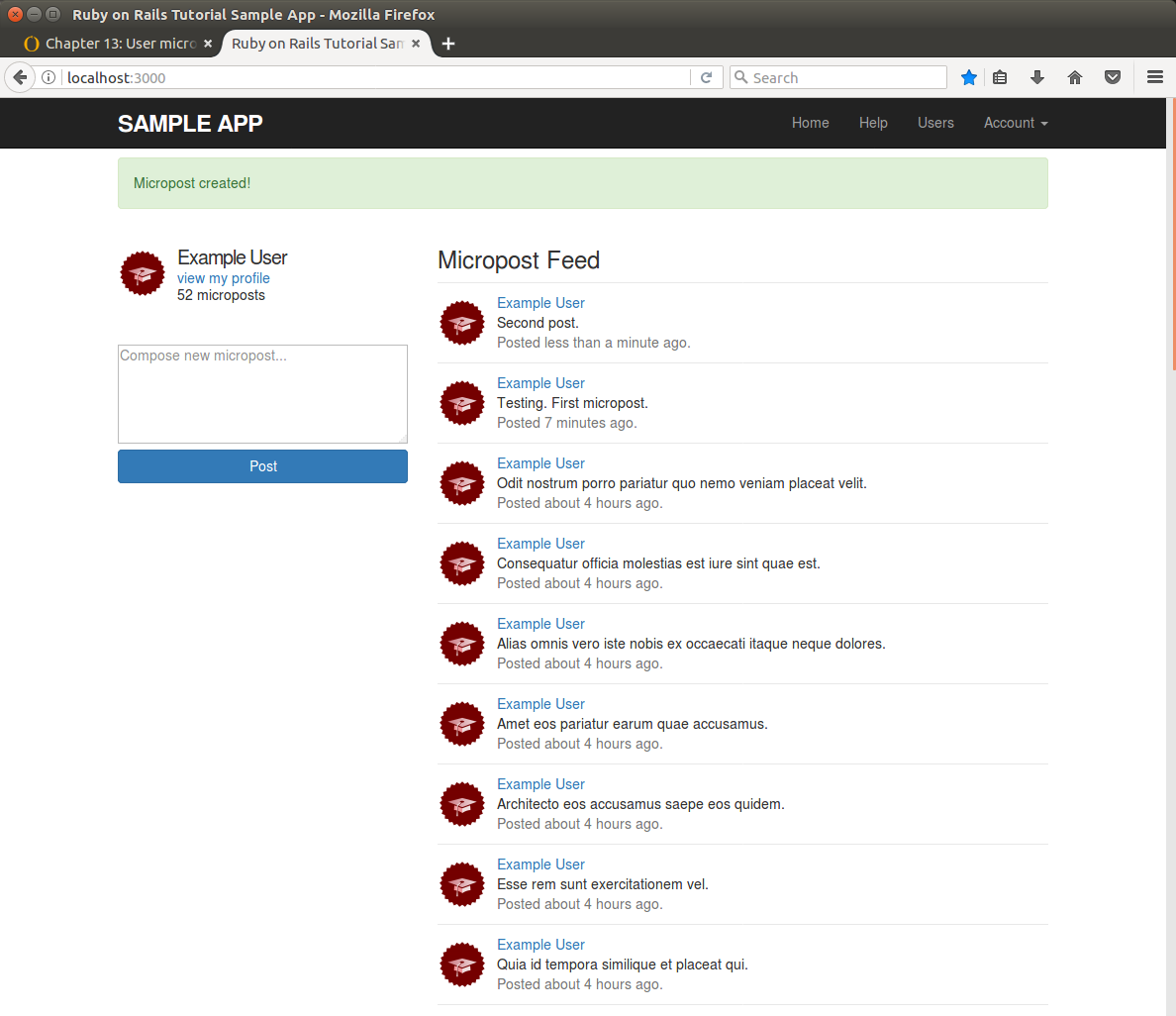
      flash[:success] = "Micropost created!"
      redirect_to root_url
    else
      render 'static_pages/home'
    end
  end   

  def destroy
  end   

  private

    def micropost_params
      params.require(:micropost).permit(:content)
    end   
   
end

Wednesday, July 19, 2017

myapp2: Completed Ch. 12 Password Reset

myapp2: ch. 12 log

$ cd myapp2
$ rails s -b 0.0.0.0 -p 3000

Firefox: http://localhost:3000/

Bracket: changed current project to myapp2.

$ git checkout -b password-reset
$ rails generate controller PasswordResets new edit --no-test-framework

config/routes.rb
  resources :password_resets,     only: [:new, :create, :edit, :update]

app/views/sessions/new.html.erb
<%= link_to "(forgot password)", new_password_reset_path %>

$ rails generate migration add_reset_to_users reset_digest:string reset_sent_at:datetime
$ rails db:migrate

app/views/password_resets/new.html.erb
<% provide(:title, "Forgot password") %>
<h1>Forgot password</h1>

<div class="row">
  <div class="col-md-6 col-md-offset-3">
    <%= form_for(:password_reset, url: password_resets_path) do |f| %>
      <%= f.label :email %>
      <%= f.email_field :email, class: 'form-control' %>

      <%= f.submit "Submit", class: "btn btn-primary" %>
    <% end %>
  </div>
</div>


app/controllers/password_resets_controller.rb
class PasswordResetsController < ApplicationController

  def new
  end

  def create
    @user = User.find_by(email: params[:password_reset][:email].downcase)
    if @user
      @user.create_reset_digest
      @user.send_password_reset_email
      flash[:info] = "Email sent with password reset instructions"
      redirect_to root_url
    else
      flash.now[:danger] = "Email address not found"
      render 'new'
    end
  end

  def edit
  end
end

app/models/user.rb
  attr_accessor :remember_token, :activation_token, :reset_token

  # Sets the password reset attributes.
  def create_reset_digest
    self.reset_token = User.new_token
    update_attribute(:reset_digest,  User.digest(reset_token))
    update_attribute(:reset_sent_at, Time.zone.now)
  end

  # Sends password reset email.
  def send_password_reset_email
    UserMailer.password_reset(self).deliver_now
  end

app/mailers/user_mailer.rb
  def password_reset(user)
    @user = user
    mail to: user.email, subject: "Password reset"
  end

app/views/user_mailer/password_reset.text.erb
To reset your password click the link below:

<%= edit_password_reset_url(@user.reset_token, email: @user.email) %>

This link will expire in two hours.

If you did not request your password to be reset, please ignore this email and
your password will stay as it is.

app/views/user_mailer/password_reset.html.erb
<h1>Password reset</h1>

<p>To reset your password click the link below:</p>

<%= link_to "Reset password", edit_password_reset_url(@user.reset_token,
                                                      email: @user.email) %>

<p>This link will expire in two hours.</p>

<p>
If you did not request your password to be reset, please ignore this email and
your password will stay as it is.
</p>

test/mailers/previews/user_mailer_preview.rb
  def password_reset
    user = User.first
    user.reset_token = User.new_token
    UserMailer.password_reset(user)
  end


app/views/password_resets/edit.html.erb
<% provide(:title, 'Reset password') %>
<h1>Reset password</h1>

<div class="row">
  <div class="col-md-6 col-md-offset-3">
    <%= form_for(@user, url: password_reset_path(params[:id])) do |f| %>
      <%= render 'shared/error_messages' %>

      <%= hidden_field_tag :email, @user.email %>

      <%= f.label :password %>
      <%= f.password_field :password, class: 'form-control' %>

      <%= f.label :password_confirmation, "Confirmation" %>
      <%= f.password_field :password_confirmation, class: 'form-control' %>

      <%= f.submit "Update password", class: "btn btn-primary" %>
    <% end %>
  </div>
</div>

app/controllers/password_resets_controller.rb
class PasswordResetsController < ApplicationController
  before_action :get_user,   only: [:edit, :update]
  before_action :valid_user, only: [:edit, :update]


  private

    def get_user
      @user = User.find_by(email: params[:email])
    end

    # Confirms a valid user.
    def valid_user
      unless (@user && @user.activated? &&
              @user.authenticated?(:reset, params[:id]))
        redirect_to root_url
      end
    end
end


app/controllers/password_resets_controller.rb
class PasswordResetsController < ApplicationController
  before_action :check_expiration, only: [:edit, :update]    # Case (1)

  def update
    if params[:user][:password].empty?                  # Case (3)
      @user.errors.add(:password, "can't be empty")
      render 'edit'
    elsif @user.update_attributes(user_params)          # Case (4)
      log_in @user
      flash[:success] = "Password has been reset."
      redirect_to @user
    else
      render 'edit'                                     # Case (2)
    end
  end

  private

    def user_params
      params.require(:user).permit(:password, :password_confirmation)
    end

    # Checks expiration of reset token.
    def check_expiration
      if @user.password_reset_expired?
        flash[:danger] = "Password reset has expired."
        redirect_to new_password_reset_url
      end
    end
end

app/models/user.rb
  # Returns true if a password reset has expired.
  def password_reset_expired?
    reset_sent_at < 2.hours.ago
  end


$ rails generate integration_test password_resets

test/integration/password_resets_test.rb
require 'test_helper'

class PasswordResetsTest < ActionDispatch::IntegrationTest

  def setup
    ActionMailer::Base.deliveries.clear
    @user = users(:jimmy)
  end

  test "password resets" do
    get new_password_reset_path
    assert_template 'password_resets/new'
    # Invalid email
    post password_resets_path, params: { password_reset: { email: "" } }
    assert_not flash.empty?
    assert_template 'password_resets/new'
    # Valid email
    post password_resets_path,
         params: { password_reset: { email: @user.email } }
    assert_not_equal @user.reset_digest, @user.reload.reset_digest
    assert_equal 1, ActionMailer::Base.deliveries.size
    assert_not flash.empty?
    assert_redirected_to root_url
    # Password reset form
    user = assigns(:user)
    # Wrong email
    get edit_password_reset_path(user.reset_token, email: "")
    assert_redirected_to root_url
    # Inactive user
    user.toggle!(:activated)
    get edit_password_reset_path(user.reset_token, email: user.email)
    assert_redirected_to root_url
    user.toggle!(:activated)
    # Right email, wrong token
    get edit_password_reset_path('wrong token', email: user.email)
    assert_redirected_to root_url
    # Right email, right token
    get edit_password_reset_path(user.reset_token, email: user.email)
    assert_template 'password_resets/edit'
    assert_select "input[name=email][type=hidden][value=?]", user.email
    # Invalid password & confirmation
    patch password_reset_path(user.reset_token),
          params: { email: user.email,
                    user: { password:              "foobaz",
                            password_confirmation: "barquux" } }
    assert_select 'div#error_explanation'
    # Empty password
    patch password_reset_path(user.reset_token),
          params: { email: user.email,
                    user: { password:              "",
                            password_confirmation: "" } }
    assert_select 'div#error_explanation'
    # Valid password & confirmation
    patch password_reset_path(user.reset_token),
          params: { email: user.email,
                    user: { password:              "foobaz",
                            password_confirmation: "foobaz" } }
    assert is_logged_in?
    assert_not flash.empty?
    assert_redirected_to user
  end   
   
end

$ rails test
$ git add -A
$ git commit -m "Add password reset"
$ git checkout master
$ git merge password-reset
$ rails test
$ git push

* The location of project myapp2 in Github was: https://github.com/jimmy2046/myapp2

Completed Ch 12: Password Reset

The Log of Chapter 12: Password reset

$ git checkout -b password-reset
$ rails generate controller PasswordResets new edit --no-test-framework

config/routes.rb
resources :password_resets,     only: [:new, :create, :edit, :update]

$ rails generate migration add_reset_to_users reset_digest:string \
> reset_sent_at:datetime
$ rails db:migrate

app/views/password_resets/new.html.erb
<% provide(:title, "Forgot password") %>
<h1>Forgot password</h1>

<div class="row">
  <div class="col-md-6 col-md-offset-3">
    <%= form_for(:password_reset, url: password_resets_path) do |f| %>
      <%= f.label :email %>
      <%= f.email_field :email, class: 'form-control' %>

      <%= f.submit "Submit", class: "btn btn-primary" %>
    <% end %>
  </div>
</div>

app/controllers/password_resets_controller.rb
  def create
    @user = User.find_by(email: params[:password_reset][:email].downcase)
    if @user
      @user.create_reset_digest
      @user.send_password_reset_email
      flash[:info] = "Email sent with password reset instructions"
      redirect_to root_url
    else
      flash.now[:danger] = "Email address not found"
      render 'new'
    end
  end

app/models/user.rb
  attr_accessor :remember_token, :activation_token, :reset_token
  # Sets the password reset attributes.
  def create_reset_digest
    self.reset_token = User.new_token
    update_attribute(:reset_digest,  User.digest(reset_token))
    update_attribute(:reset_sent_at, Time.zone.now)
  end

  # Sends password reset email.
  def send_password_reset_email
    UserMailer.password_reset(self).deliver_now
  end

app/mailers/user_mailer.rb
  def password_reset(user)
    @user = user
    mail to: user.email, subject: "Password reset"
  end

app/views/user_mailer/password_reset.text.erb
To reset your password click the link below:

<%= edit_password_reset_url(@user.reset_token, email: @user.email) %>

This link will expire in two hours.

If you did not request your password to be reset, please ignore this email and
your password will stay as it is.

app/views/user_mailer/password_reset.html.erb
<h1>Password reset</h1>

<p>To reset your password click the link below:</p>

<%= link_to "Reset password", edit_password_reset_url(@user.reset_token,
                                                      email: @user.email) %>

<p>This link will expire in two hours.</p>

<p>
If you did not request your password to be reset, please ignore this email and
your password will stay as it is.
</p>

$ rails generate migration add_reset_sent_to_users reset_sent_at:datetime
$ rails db:migrate

app/views/password_resets/edit.html.erb
<% provide(:title, 'Reset password') %>
<h1>Reset password</h1>

<div class="row">
  <div class="col-md-6 col-md-offset-3">
    <%= form_for(@user, url: password_reset_path(params[:id])) do |f| %>
      <%= render 'shared/error_messages' %>

      <%= hidden_field_tag :email, @user.email %>

      <%= f.label :password %>
      <%= f.password_field :password, class: 'form-control' %>

      <%= f.label :password_confirmation, "Confirmation" %>
      <%= f.password_field :password_confirmation, class: 'form-control' %>

      <%= f.submit "Update password", class: "btn btn-primary" %>
    <% end %>
  </div>
</div>

app/controllers/password_resets_controller.rb
class PasswordResetsController < ApplicationController
  before_action :get_user,   only: [:edit, :update]
  before_action :valid_user, only: [:edit, :update]
  .
  .
  .
  def edit
  end

  private

    def get_user
      @user = User.find_by(email: params[:email])
    end

    # Confirms a valid user.
    def valid_user
      unless (@user && @user.activated? &&
              @user.authenticated?(:reset, params[:id]))
        redirect_to root_url
      end
    end
end

app/controllers/password_resets_controller.rb
class PasswordResetsController < ApplicationController
  before_action :get_user,         only: [:edit, :update]
  before_action :valid_user,       only: [:edit, :update]
  before_action :check_expiration, only: [:edit, :update]    # Case (1)

  def new
  end

  def create
    @user = User.find_by(email: params[:password_reset][:email].downcase)
    if @user
      @user.create_reset_digest
      @user.send_password_reset_email
      flash[:info] = "Email sent with password reset instructions"
      redirect_to root_url
    else
      flash.now[:danger] = "Email address not found"
      render 'new'
    end
  end

  def edit
  end

  def update
    if params[:user][:password].empty?                  # Case (3)
      @user.errors.add(:password, "can't be empty")
      render 'edit'
    elsif @user.update_attributes(user_params)          # Case (4)
      log_in @user
      flash[:success] = "Password has been reset."
      redirect_to @user
    else
      render 'edit'                                     # Case (2)
    end
  end

  private

    def user_params
      params.require(:user).permit(:password, :password_confirmation)
    end

    # Before filters

    def get_user
      @user = User.find_by(email: params[:email])
    end

    # Confirms a valid user.
    def valid_user
      unless (@user && @user.activated? &&
              @user.authenticated?(:reset, params[:id]))
        redirect_to root_url
      end
    end

    # Checks expiration of reset token.
    def check_expiration
      if @user.password_reset_expired?
        flash[:danger] = "Password reset has expired."
        redirect_to new_password_reset_url
      end
    end

app/models/user.rb
  # Returns true if a password reset has expired.
  def password_reset_expired?
    reset_sent_at < 2.hours.ago
  end


$ rails generate integration_test password_resets

test/integration/password_resets_test.rb
require 'test_helper'

class PasswordResetsTest < ActionDispatch::IntegrationTest

  def setup
    ActionMailer::Base.deliveries.clear
    @user = users(:michael)
  end

  test "password resets" do
    get new_password_reset_path
    assert_template 'password_resets/new'
    # Invalid email
    post password_resets_path, params: { password_reset: { email: "" } }
    assert_not flash.empty?
    assert_template 'password_resets/new'
    # Valid email
    post password_resets_path,
         params: { password_reset: { email: @user.email } }
    assert_not_equal @user.reset_digest, @user.reload.reset_digest
    assert_equal 1, ActionMailer::Base.deliveries.size
    assert_not flash.empty?
    assert_redirected_to root_url
    # Password reset form
    user = assigns(:user)
    # Wrong email
    get edit_password_reset_path(user.reset_token, email: "")
    assert_redirected_to root_url
    # Inactive user
    user.toggle!(:activated)
    get edit_password_reset_path(user.reset_token, email: user.email)
    assert_redirected_to root_url
    user.toggle!(:activated)
    # Right email, wrong token
    get edit_password_reset_path('wrong token', email: user.email)
    assert_redirected_to root_url
    # Right email, right token
    get edit_password_reset_path(user.reset_token, email: user.email)
    assert_template 'password_resets/edit'
    assert_select "input[name=email][type=hidden][value=?]", user.email
    # Invalid password & confirmation
    patch password_reset_path(user.reset_token),
          params: { email: user.email,
                    user: { password:              "foobaz",
                            password_confirmation: "barquux" } }
    assert_select 'div#error_explanation'
    # Empty password
    patch password_reset_path(user.reset_token),
          params: { email: user.email,
                    user: { password:              "",
                            password_confirmation: "" } }
    assert_select 'div#error_explanation'
    # Valid password & confirmation
    patch password_reset_path(user.reset_token),
          params: { email: user.email,
                    user: { password:              "foobaz",
                            password_confirmation: "foobaz" } }
    assert is_logged_in?
    assert_not flash.empty?
    assert_redirected_to user
  end   
   
end

$ rails test
$ git add -A
$ git commit -m "Add password reset"
$ git checkout master
$ git merge password-reset
$ rails test
$ git push

* The Github address was: https://github.com/jimmy2046/sample_app

Monday, July 17, 2017

Chapter 11 in My Own Style myapp2

* In Brackets, I switched the project folder to myapp2.

* Then I started the Ruby on Rails server.
$ cd myapp2
$ rails s -b 0.0.0.0 -p 3000

* In Firefox, I typed: http://localhost:3000/

* For chapter 11, most of the coding are just the same no matter how is the CSS stylesheet and the metadata with one single name field in opposite to two first name and last name fields. I am going to do project myapp2 in "Fast Forward Mode". The instructions from the  book can be found on : https://www.railstutorial.org/book/account_activation And the source code on my project myapp2 can be found on: https://github.com/jimmy2046/myapp2.


*  I made minor change to the :before_action in User Controller.
That was a user must log in in order to use the "show" action to view other user's profiles.
myapp2/app/controller/users_controller.rb
  before_action :logged_in_user, only: [:index, :show, :edit, :update, :destroy]

How to kill an abandoned process in Linux/Unix

I remembered it, then I forgot, then I remembered it, and then I forgot again. In case of a Linux/Unit process hang, I have to figure out ...